How to Verify an Online Casino Is Safe (Not Just 'Licensed')
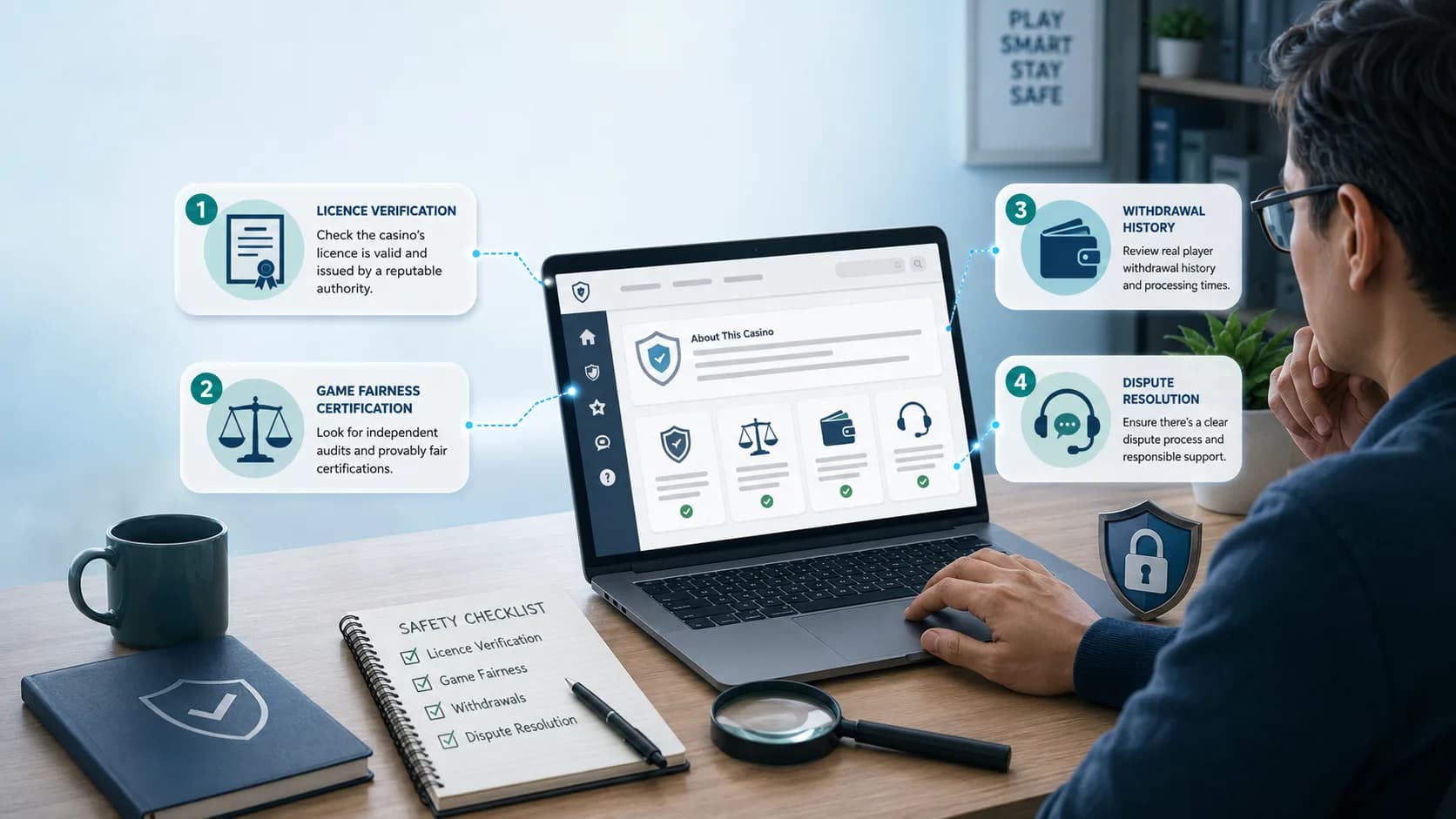
“Licensed and regulated” is one of the most repeated phrases in online gambling marketing. On its own, however, it tells a player very little.
A genuine licence from a credible regulator is an important baseline, but it is not a complete guarantee of safety. A licensed operator may still have unclear bonus conditions, slow complaint handling, inconsistent withdrawal performance, or confusing verification procedures.
A more useful question is not simply, “Is this casino licensed?” It is:
Can its safety claims be independently checked?
This guide explains how to assess whether a gambling website shows meaningful signs of consumer protection, fairness, payment reliability, and accountability.
This article is intended for consumer-safety education. It does not recommend gambling or any particular gambling website. Online gambling is restricted to people who meet the legal age requirements in their jurisdiction.
Why “Licensed” Does Not Automatically Mean “Safe”
A licence matters because it establishes that an operator is subject to rules and regulatory oversight. Depending on the market, players may encounter regulators and regulated-market bodies such as:
- the Alcohol and Gaming Commission of Ontario and iGaming Ontario in Ontario;
- the UK Gambling Commission in Great Britain;
- the Malta Gaming Authority in Malta.
These organizations maintain public information about authorized or licensed operators. That makes it possible to check a claim instead of trusting a badge in a website footer.
However, licensing is only one part of a broader safety assessment. A licensed operator can still provide a poor player experience through:
- unclear terms and conditions;
- delayed or inconsistent withdrawals;
- repeated requests for documents without adequate explanation;
- weak complaint handling;
- conflicting information from customer support;
- restrictive bonus conditions that are difficult to understand.
A credible safety review should therefore examine several independent indicators together.
What a “Safe Online Casino” Should Actually Mean
The phrase safe online casino should describe more than marketing language. At minimum, it should refer to an operator that can demonstrate:
- a licence or authorization that can be independently verified;
- appropriate independent testing of games or gambling systems;
- transparent withdrawal rules and a credible payment record;
- a clear and usable complaints process;
- transparent identity-verification, privacy, and account-security procedures.
No single badge proves all of these things. The goal is to build a consistent picture from several checks.
1. Verify the Licence, Not Just the Licence Claim
Any website can display a regulator’s name, a seal, or a “licensed” label. The first practical check is whether the operator appears in the regulator’s own public records.
Information to compare
Look for the following details on the website:
- the legal name of the operating company;
- the licence, registration, or account number;
- the regulator or regulated market named;
- the website domains covered by the authorization;
- the current status of the authorization;
- any restrictions, suspensions, or enforcement information.
The casino’s brand name may differ from the legal entity that operates it. That is not automatically a problem, but the relationship should be traceable.
How to perform the check
- Find the legal and licensing information in the website footer or terms and conditions.
- Note the company name, licence number, regulator, and domain.
- Open the regulator’s official public register independently.
- Search using the company name, trading name, domain, or licence number.
- Confirm that the authorization is active and covers the website you are viewing.
Do not rely solely on a link supplied by the gambling website. A copied page, misleading redirect, or fake seal can make an unauthorized site appear legitimate.
Licence-related warning signs
Treat the following as serious warning signs:
- no legal entity is identified;
- no licence or registration information is provided;
- the licence number does not appear in the official register;
- the registered company does not match the company named in the terms;
- the domain is not associated with the licensed operator;
- the authorization is suspended, inactive, or otherwise restricted;
- the site refers vaguely to “international licensing” without naming a regulator.
2. Look for Independent Game and System Testing
A casino should not be the only party claiming that its games are fair.
Independent testing laboratories assess gambling products and systems against technical or jurisdictional requirements. Examples commonly associated with gambling testing and certification include eCOGRA, Gaming Laboratories International, and iTech Labs.
Testing may cover areas such as:
- random number generators;
- game mathematics;
- payout calculations;
- platform integrations;
- technical security controls;
- compliance with jurisdiction-specific standards.
What independent testing does and does not prove
Independent testing can provide evidence that a specific game, system, or component was assessed against defined requirements.
It does not automatically prove that:
- every game on the website was tested by the same laboratory;
- the operator handles withdrawals properly;
- bonus terms are fair or easy to understand;
- customer support resolves disputes effectively;
- a certification is current or applies to the exact platform being used.
The scope of the certification matters. A testing logo without supporting information is weaker evidence than a traceable certificate or a clear explanation of what was assessed.
Fairness-related warning signs
Be cautious when a website:
- claims games are “100% fair” without evidence;
- displays a testing logo but provides no supporting details;
- does not identify its game providers;
- cannot explain whether certification applies to games, the platform, or both;
- presents an outdated or unverifiable certificate;
- suggests that a licence alone proves every game is fair.
3. Examine Withdrawal Rules Before Depositing
Withdrawal reliability is one of the most practical indicators of how an operator treats its customers.
Marketing claims such as “instant withdrawals” or “fast payouts” may apply only in limited circumstances. Processing time can depend on:
- the payment method;
- whether identity verification is complete;
- internal pending periods;
- weekends or banking schedules;
- transaction limits;
- additional security reviews;
- the operator’s own processing practices.
The important question is not whether a website uses the word “instant.” It is whether the full withdrawal process is explained clearly and performs consistently.
What to review
Before relying on a withdrawal-speed claim, check:
- estimated processing times for each payment method;
- minimum and maximum withdrawal amounts;
- daily, weekly, or monthly payout limits;
- withdrawal fees;
- pending or reversal periods;
- identity-verification requirements;
- whether deposits must be returned through the original method;
- conditions linked to bonuses or wagering;
- circumstances in which a withdrawal may be delayed or rejected.
Use real evidence, not promotional claims
A strong review methodology should compare published policies with observed or documented results. Useful evidence may include:
- verified test withdrawals;
- timestamped payment records;
- support correspondence;
- recurring complaint patterns;
- aggregated withdrawal data across reviewed operators:
- Number of reviewed operators: 24
- Review period: January 1, 2026 – June 30, 2026
- Median e-wallet withdrawal time: 7.5 hours
- Median bank or card withdrawal time: 2.8 business days
- Percentage completed within the advertised period: 79%
- Methodology / Limitations: This fictional dataset assumes one documented withdrawal per payment method and operator. It excludes cancelled withdrawals, failed payment-provider transactions, weekends, public holidays, and cases where identity verification was incomplete.
Withdrawal-related warning signs
Be cautious when:
- the withdrawal policy is missing or difficult to locate;
- the advertised speed excludes internal processing time;
- identity checks are mentioned only after a withdrawal request;
- fees or limits are not disclosed clearly;
- customer support gives conflicting processing estimates;
- complaints show repeated delays with similar explanations;
- the operator repeatedly cancels withdrawals back to the playing balance;
- terms allow broad withholding of funds without a clear review process.
4. Review How Complaints and Disputes Are Handled
An operator’s real safety profile becomes clearest when something goes wrong.
Typical disputes may involve:
- a delayed withdrawal;
- account restrictions;
- identity-verification problems;
- disputed bonus terms;
- voided winnings;
- deposit or payment errors;
- unauthorized account access;
- technical interruptions.
A safer operator should explain how a complaint can be submitted, reviewed, escalated, and resolved.
What a clear complaints process should include
Look for:
- a dedicated complaints procedure;
- contact methods beyond a generic live-chat widget;
- expected response or review timeframes;
- instructions for escalation;
- information about external dispute resolution, where applicable;
- a requirement for written reasons when a decision affects funds or account access;
- a way to preserve the complaint history and evidence.
Test support before providing payment details
A simple pre-deposit support question can reveal how clearly the operator communicates.
For example, ask where to find:
- withdrawal limits;
- verification requirements;
- bonus restrictions;
- the formal complaints process.
The objective is not to test whether support is friendly. It is to check whether answers are specific, consistent, and supported by written policies.
Dispute-related warning signs
Be cautious when:
- there is no formal complaint pathway;
- support refuses to provide written explanations;
- different agents give contradictory answers;
- the operator repeatedly cites “security reasons” without explaining the review process;
- terms give the operator unlimited discretion without defined safeguards;
- complaints remain unresolved for long periods without updates;
- the site does not explain external escalation options where such mechanisms exist.
5. Read the Bonus Terms as a Risk Document
A bonus can create restrictions that do not apply to ordinary cash balances. Before accepting one, examine the terms as carefully as the promotional headline.
Important conditions may include:
- wagering requirements;
- eligible and excluded games;
- maximum stake while wagering;
- expiry periods;
- contribution percentages;
- maximum convertible or withdrawable winnings;
- payment-method exclusions;
- country or location restrictions;
- identity or account-status conditions;
- rules against irregular play or bonus abuse.
The presence of conditions is not automatically evidence of wrongdoing. The risk arises when conditions are hidden, contradictory, applied retroactively, or written so broadly that a player cannot predict the outcome.
Bonus-term warning signs
Be cautious when:
- the main promotional page omits important restrictions;
- the complete terms are difficult to find;
- material rules appear only after registration;
- different pages contain conflicting conditions;
- vague clauses allow confiscation without a defined investigation;
- the operator changes the relevant terms after a player has accepted the offer.
6. Check Identity Verification, Privacy, and Account Security
Identity verification is common in regulated gambling environments, but the process should be transparent and proportionate.
Before submitting personal documents, confirm:
- why the information is required;
- which documents may be requested;
- how documents can be uploaded securely;
- how personal information is stored and protected;
- whether a privacy policy identifies the legal entity processing the data;
- how long verification may take;
- what happens if documents cannot be verified;
- how to contact the privacy or support team.
Security warning signs
Do not send sensitive documents when:
- the site has no clear privacy policy;
- the upload method appears insecure;
- documents are requested through informal messaging channels;
- the legal entity receiving the information is unclear;
- support requests passwords or full payment credentials;
- the operator cannot explain why a document is needed;
- the website domain differs unexpectedly from the domain identified in official records.
A Practical Online Casino Safety Checklist
Use the following checklist as a consumer-protection screen. It cannot eliminate all risk, but it can expose obvious inconsistencies before personal or payment information is submitted.
Licence and legal identity
- The legal operator is clearly identified.
- The licence or registration details appear in an official public register.
- The domain is associated with the authorized operator.
- The authorization is active.
- Relevant enforcement information has been reviewed.
Fairness and technical integrity
- The website identifies its game providers.
- Independent testing or certification claims are traceable.
- The scope of testing is explained.
- Certification appears current and relevant to the product.
Withdrawals and payments
- Processing times are stated by payment method.
- Fees and transaction limits are disclosed.
- Verification requirements are explained in advance.
- Bonus-related withdrawal restrictions are clear.
- Available evidence does not show a repeated pattern of unresolved payout problems.
Complaints and support
- A formal complaint process is available.
- Escalation steps are explained.
- Support answers are specific and consistent.
- External dispute options are identified where applicable.
- Decisions affecting funds can be provided in writing.
Privacy and account security
- The privacy policy identifies the data controller.
- Documents can be uploaded securely.
- The reasons for verification are explained.
- The website never requests passwords or full payment credentials.
- Security and account-recovery procedures are available.
Common Red Flags at a Glance
Stop and investigate further when a gambling website shows several of these signs:
- unverifiable or missing licence information;
- no identifiable legal operator;
- a domain that does not match official records;
- vague fairness claims without evidence;
- missing withdrawal rules;
- hidden fees or payout limits;
- repeated unresolved complaints;
- contradictory support responses;
- unclear bonus restrictions;
- unsafe requests for identity documents;
- pressure to deposit quickly;
- claims that seem designed to prevent independent checking.
One warning sign may have an explanation. A pattern of warning signs is more significant.
Why This Framework Matters
None of the core checks in this guide requires trusting a marketing badge.
A consumer can independently examine:
- whether the operator is authorized;
- whether testing claims are traceable;
- whether payment rules are transparent;
- whether withdrawal evidence supports advertised claims;
- whether disputes follow a defined process;
- whether personal data is handled through clear security procedures.
That is the practical difference between “safe” as a marketing word and safety as a set of checkable conditions.
Final Thoughts
Do not treat “licensed and regulated” as the final answer. Treat it as the first item on a broader verification checklist.
A gambling website presents a stronger safety case when all of the following are supported by evidence:
- verifiable authorization;
- traceable independent testing;
- clear payment and withdrawal rules;
- a credible withdrawal record;
- transparent bonus conditions;
- a structured complaints process;
- secure identity and privacy practices.
When important information is missing, inconsistent, or impossible to verify, the safest response is not to submit personal data or deposit funds.
Frequently Asked Questions
Is a licensed online casino always safe?
No. Licensing is an important baseline, but it does not guarantee clear terms, reliable withdrawals, effective support, or satisfactory complaint handling. Several independent indicators should be reviewed together.
How can a casino licence be verified?
Identify the legal operator, licence or registration number, regulator, and website domain. Then compare those details with the regulator’s official public register.
Does an RNG certificate prove the entire casino is safe?
No. RNG or game certification may apply to a particular game, system, or technical component. It does not by itself verify withdrawal practices, bonus rules, customer support, privacy, or dispute handling.
Why are advertised withdrawal times not always reliable?
The headline may exclude identity verification, internal pending periods, banking schedules, transaction limits, or payment-provider processing. The complete withdrawal policy and documented performance provide more useful evidence.
What are the most serious warning signs?
Unverifiable licence claims, an unidentified legal operator, unclear withdrawal policies, unsafe document requests, contradictory support answers, and repeated unresolved complaints are major warning signs.
What should a player do when information cannot be verified?
Do not provide identity documents, payment information, or a deposit until the inconsistency has been resolved through reliable and independent information.